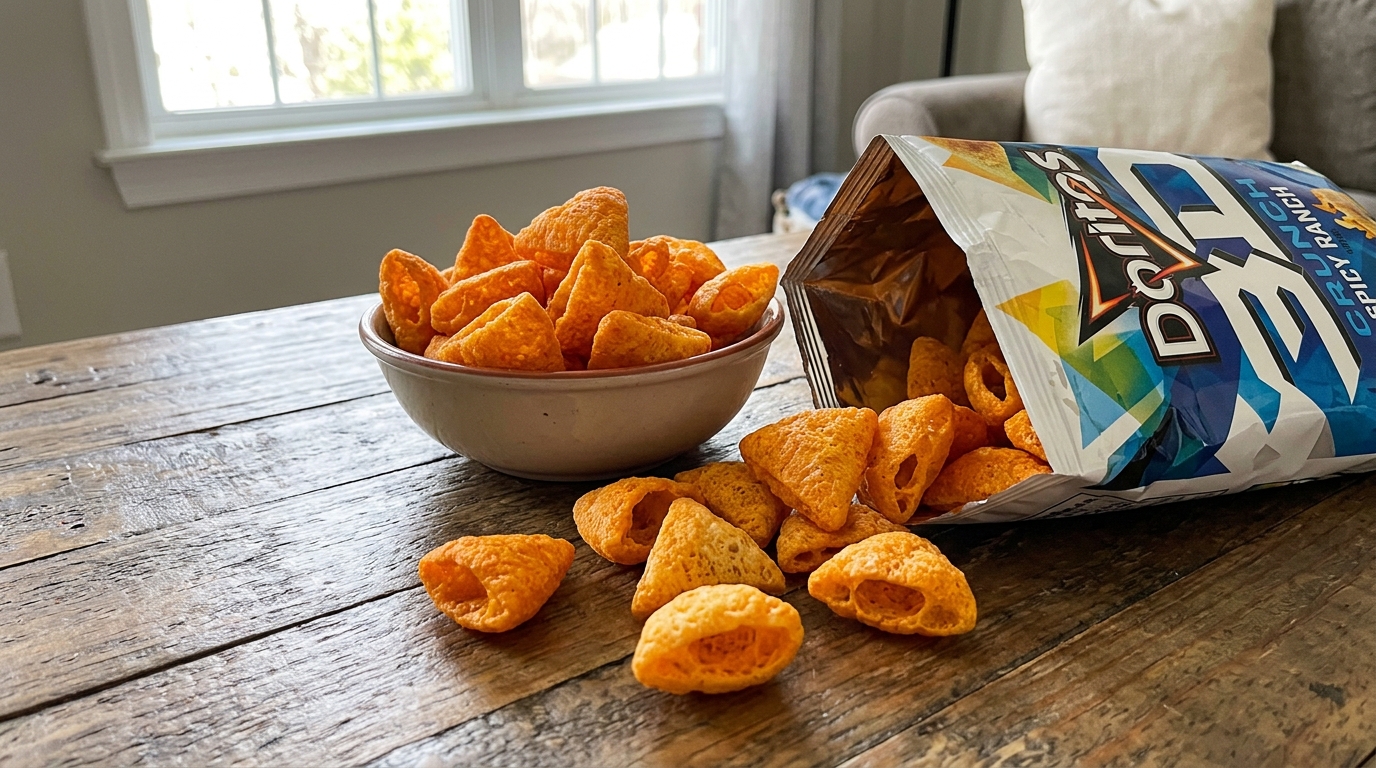
Doritos 3D were puffed, hollow corn snacks introduced by Frito-Lay in 1998 as a three-dimensional alternative to traditional flat Doritos tortilla chips. Sold in flavors including Nacho Cheese, Zesty Ranch, and Jalapeño Cheddar, the unusual snacks became famous through a memorable Super Bowl commercial starring Ali Landry. The original Doritos 3D line disappeared in the early 2000s but developed a powerful nostalgia following. Frito-Lay revived the concept as Doritos 3D Crunch in late 2020 with new flavors, although the revived version also eventually disappeared from widespread U.S. distribution.
The Story
History of Doritos 3D
For decades, the basic shape of a Dorito was obvious.
It was flat.
It was triangular.
Then Frito-Lay decided to inflate it.
Doritos 3D arrived nationally in 1998 as one of the most visually unusual extensions in the history of the Doritos brand.
Instead of ordinary flat tortilla chips, the snacks were puffed into hollow three-dimensional shapes.
They retained the triangular identity associated with Doritos but expanded outward into something closer to a small crunchy shell.
The result looked futuristic, particularly by late-1990s snack-food standards.
Frito-Lay offered the original product in flavors including Nacho Cheese, Zesty Ranch, and Jalapeño Cheddar.
But the shape was the real attraction.
Consumers already knew what Doritos tasted like.
Doritos 3D gave them a reason to experience the brand again simply because eating them felt different.
The launch received an enormous boost from advertising.
During the 1998 Super Bowl, Doritos aired a commercial commonly known as "Laundromat" featuring model and actress Ali Landry.
In the commercial, Landry catches flying Doritos 3D in her mouth while stunned onlookers watch.
The advertisement became enormously popular and transformed Landry into the "Doritos Girl."
The association became one of the most recognizable snack advertising campaigns of the late 1990s.
Doritos 3D fit perfectly into the consumer culture surrounding it.
The late 1990s and early 2000s were filled with products designed to transform familiar foods into unusual shapes, colors, textures, and experiences.
Food companies increasingly marketed products as entertainment.
Ordinary ketchup became green or purple.
Soda became electric blue.
Candy became interactive.
And Doritos became three-dimensional.
Packaging reinforced the novelty.
Some versions were sold in bags while smaller servings could be found in distinctive containers that made the product feel even more like a futuristic snack than a conventional bag of chips.
The unusual hollow structure also created a different eating experience.
Doritos 3D were lighter and puffier than standard Doritos, with a crunch that fans distinctly remembered even decades later.
That difference eventually became important.
The product performed strongly enough that Frito-Lay would later describe Doritos 3D as one of the brand's most successful product innovations.
But success did not make the product permanent.
During the early 2000s, original Doritos 3D gradually disappeared from American stores.
Frito-Lay continued producing ordinary Doritos and constantly introduced new flavors and variations, but the puffed 3D format was phased out.
That could easily have been the end of the story.
Instead, the absence made people want them more.
As 1990s nostalgia grew, Doritos 3D became one of the snacks consumers repeatedly asked Frito-Lay to bring back.
Social media posts, petitions, nostalgia articles, and discussions kept the product visible long after the original chips disappeared.
The demand became strong enough that Frito-Lay eventually listened.
In December 2020, the company announced Doritos 3D Crunch.
The product retained the recognizable three-dimensional concept but was updated with new flavors: Chili Cheese Nacho and Spicy Ranch.
Frito-Lay even brought Ali Landry back to help promote the revival, deliberately connecting the new product to the famous 1998 advertising campaign.
A discontinued snack had officially returned more than fifteen years after disappearing.
What Happened?
Why was Doritos 3D discontinued?
The original Doritos 3D were phased out during the early 2000s despite having been a successful and highly recognizable Doritos product.
Frito-Lay has publicly acknowledged the original product's popularity but has not provided a detailed explanation identifying one specific reason for its discontinuation.
That makes it important not to invent one.
The most likely explanation is that Doritos 3D followed the normal lifecycle of a snack-food innovation.
Novelty products can generate enormous attention when introduced because consumers want to try something new. Maintaining that demand over many years is considerably harder.
Doritos 3D also required Frito-Lay to maintain a separate physical format rather than simply applying a new seasoning to the company's standard triangular tortilla chips.
Frito-Lay could continuously create new Doritos varieties using the established flat-chip platform, while the 3D product occupied its own manufacturing and retail niche.
Whatever commercial considerations ultimately drove the decision, the company phased the original product out during the early 2000s.
The discontinuation eventually produced an outcome Frito-Lay may not have anticipated.
People kept asking for it.
Doritos 3D became a recurring feature of discontinued-snack discussions, social media campaigns, petitions, and lists of foods consumers wanted manufacturers to revive.
The requests continued for years.
Eventually, the nostalgia became commercially valuable enough for Frito-Lay to reconsider the idea.
In late 2020, the company announced Doritos 3D Crunch, explicitly presenting the new product as an updated version of the beloved 1998 original.
The comeback demonstrated that discontinuation had not erased demand.
It had helped transform Doritos 3D from another product variation into a piece of 1990s nostalgia.
Afterward
What happened afterward?
Doritos 3D became one of the most requested discontinued products in Frito-Lay's history.
The unusual shape helped.
Consumers could buy countless discontinued Doritos flavors over the years, but Doritos 3D represented something fundamentally different from the normal chip.
People remembered the texture.
They remembered the hollow shape.
They remembered the packaging.
And they remembered Ali Landry catching them in her mouth in the famous 1998 commercial.
As nostalgia for the 1990s expanded during the 2010s, those memories became increasingly visible online.
Fans petitioned for the snack's return and repeatedly contacted Frito-Lay.
The company eventually responded.
In December 2020, Frito-Lay announced that Doritos 3D would return as Doritos 3D Crunch.
The revived snacks reached stores at the end of that year and were offered in Chili Cheese Nacho and Spicy Ranch flavors.
Frito-Lay deliberately connected the revival to the original.
Ali Landry returned to promote the product, while advertising referenced the famous 1998 launch.
Doritos subsequently promoted 3D Crunch during the 2021 Super Bowl with a major campaign featuring Matthew McConaughey, Jimmy Kimmel, and Mindy Kaling.
But the comeback also demonstrated one of the complications involved in reviving a nostalgic food.
Consumers were not simply asking for something shaped like Doritos 3D.
They remembered a particular texture and particular flavors.
Some longtime fans felt the revived 3D Crunch differed from the original product they remembered.
The original varieties such as Jalapeño Cheddar, Nacho Cheese, and Zesty Ranch had been replaced with newer flavor combinations.
Doritos 3D Crunch itself eventually became difficult to find and disappeared again from widespread U.S. distribution.
That leaves the original Doritos 3D in an unusual position.
It was successful enough to become a defining late-1990s snack.
It disappeared.
Fans spent years demanding its return.
Frito-Lay brought the concept back.
And yet the specific original product people remembered still belongs to the past.
Today, Doritos 3D represents almost a perfect example of the nostalgia cycle surrounding discontinued food.
A product can disappear because its original commercial moment has ended, become more desirable precisely because consumers can no longer buy it, and eventually become valuable enough to revive decades later.
Sometimes even the revival cannot replace the original in people's memories.
References