
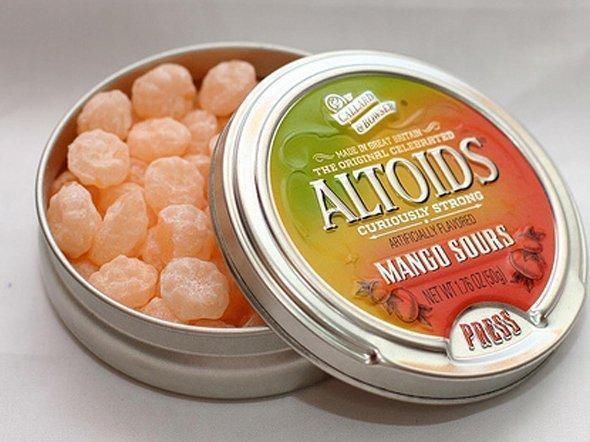
Altoids Sours were intensely tart hard candies sold in small metal tins under the Altoids brand. Introduced in 2001, they became a cult favorite for flavors such as Tangerine, Citrus, Raspberry, Apple, and Mango before disappearing in 2010. Their combination of extreme sourness, distinctive tins, and early-2000s branding helped turn them into one of the most frequently requested discontinued candies of their era.
The Story
History of Altoids Sours
Altoids built its reputation on extremely strong mints, but in 2001 the brand moved into a very different kind of intensity.
That year, Altoids introduced Sours.
Instead of delivering the powerful peppermint or cinnamon experience associated with the brand, Altoids Sours focused on sharp fruit flavors and an aggressive sour coating.
The candies were small, round hard candies packaged in metal tins similar to the containers already associated with Altoids.
That packaging mattered.
The tins gave Altoids Sours a distinctive identity in a candy aisle dominated by plastic bags, cardboard boxes, and wrappers. The product looked more substantial and collectible than a typical sour candy.
Multiple fruit varieties appeared over the product's run, including Tangerine, Citrus, Raspberry, Mango, and Apple.
Tangerine became especially closely associated with the line and remains one of the flavors most frequently mentioned by former fans.
The product arrived during a period when intensely sour candy had become increasingly popular.
Brands such as Warheads had already demonstrated that consumers—especially younger ones—were willing to seek out candy partly for the challenge of eating something extremely sour.
Altoids approached that trend from a slightly different direction.
The brand already had an established identity built around strength. Its famous "Curiously Strong" positioning translated surprisingly well from breath mints to sour candy.
Instead of being curiously strong in peppermint, Altoids Sours were curiously strong in acidity.
For consumers who liked them, the appeal was not subtle.
The candies developed a reputation for a sour coating strong enough to make the mouth react immediately, followed by a sweeter fruit-flavored hard candy underneath.
Their metal tins also became part of the nostalgia.
People reused them for coins, small electronics, craft supplies, and countless other purposes after the candy was gone.
For nearly a decade, Altoids Sours occupied an unusual place in the candy market.
Then, around 2010, the tins began disappearing from stores.
What Happened?
Why was Altoids Sours discontinued?
Altoids Sours were discontinued in 2010.
Mars and Wrigley did not publish a detailed public postmortem specifically explaining the end of the Sours line, but correspondence from Wrigley around the same period provides a clear indication of the company's reasoning for discontinued Altoids products.
In a response shared publicly in 2010, Wrigley explained that it sometimes discontinued products when consumer demand remained too low over time.
That explanation fits the broader pattern surrounding Altoids Sours.
The candy clearly had passionate fans, but passionate nostalgia does not necessarily mean a product had enough national sales to justify remaining in a major confectionery portfolio.
Altoids itself continued.
The core mint products remained established sellers, and Mars continues to market Altoids Peppermint, Wintergreen, Cinnamon, Smalls, and other mint-focused products.
Sours, however, represented a side category rather than the brand's core business.
Once sales weakened, maintaining multiple sour flavors, packaging, retail shelf space, and production capacity may no longer have made commercial sense.
What made the discontinuation unusual was what happened afterward.
Instead of fading from memory, Altoids Sours became dramatically more desirable once they were gone.
Old unopened tins began appearing on resale sites.
Empty tins themselves became collectible.
Former customers repeatedly asked whether the candies would return.
The product therefore became a classic example of a discontinued item whose nostalgia audience became more visible after the product was no longer available.
Afterward
What happened afterward?
Altoids Sours developed an unusually strong afterlife.
Years after the candy disappeared, fans continued discussing the flavors, hunting for unopened tins, and asking Mars to bring the product back.
The nostalgia became strong enough to create a market for recreation.
In 2024, Iconic Candy introduced Retro Sours, a new line explicitly inspired by the discontinued Altoids Sours.
The revived candies included familiar flavors such as Tangerine, Citrus, and Mango and were packaged in small metal tins designed to evoke the original experience.
Retro Sours are not technically Altoids Sours.
They are not sold under the Altoids brand, and Mars does not manufacture them as an official continuation of the original product.
But their existence demonstrates how much demand remained for the concept.
The story is especially interesting because the original product disappeared because it apparently did not generate enough sustained demand, yet more than a decade later another company saw enough nostalgia-driven interest to recreate the experience.
Altoids Sours therefore occupy a strange position today.
The original product remains discontinued.
But the flavor concept, packaging nostalgia, and reputation for extreme sourness became valuable enough to inspire a modern revival under a different name.
That makes Altoids Sours one of the clearest examples of how discontinued products can become culturally stronger after disappearing.
References