The iPod Classic was Apple's iconic hard-drive-based portable music player and the direct descendant of the original iPod introduced in 2001. Built around the famous scroll wheel and later Click Wheel interface, the iPod transformed portable music by allowing consumers to carry thousands of songs in a pocket-sized device. Apple formally adopted the iPod classic name in 2007 and eventually offered a 160 GB model capable of holding an enormous music library. The iPhone and streaming era gradually made dedicated high-capacity music players less essential, and Apple discontinued the iPod Classic in 2014.
The Story
History of Apple iPod Classic
The device eventually known as the iPod Classic began with one of the most consequential product launches in Apple's history.
On October 23, 2001, Apple introduced the original iPod.
Portable digital music players already existed, but many suffered from limited storage, awkward interfaces, slow file transfers, or bulky designs. Apple attempted to solve those problems with a compact player built around a small hard drive, fast computer synchronization, and an interface that made navigating a large music library unusually simple.
The original iPod held approximately 1,000 songs on its 5 GB hard drive.
Its most recognizable feature was the large circular scroll wheel on the front.
Instead of repeatedly pressing buttons to move through hundreds or thousands of songs, users could rapidly scroll through menus and lists with their thumb.
Apple paired the hardware with iTunes, creating an increasingly integrated system for organizing music on a computer and transferring it to a portable device.
The combination became enormously influential.
Early iPods were primarily aimed at Mac users, but Apple subsequently expanded compatibility with Windows and continued improving both iTunes and the hardware.
The iPod evolved rapidly.
Storage capacities increased. The mechanical scroll wheel gave way to touch-sensitive controls. Apple eventually introduced the Click Wheel, which combined navigation and buttons into the circular interface that became one of the most recognizable pieces of consumer-electronics design of the 2000s.
The iPod also became thinner and more capable.
Color displays arrived. Photo viewing became possible. The fifth-generation iPod introduced video playback, allowing users to carry television episodes, music videos, and other video content alongside their music.
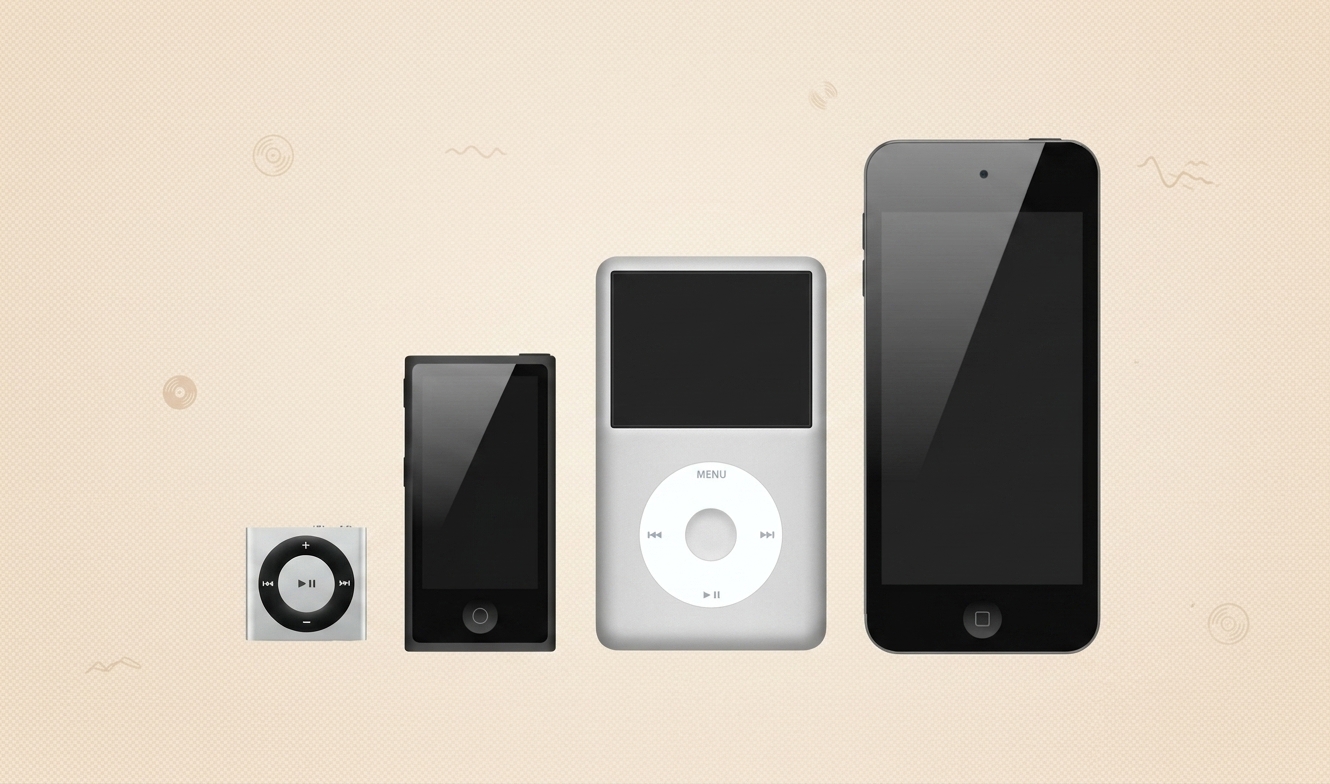
At the same time, Apple expanded iPod into an entire product family.
The iPod mini offered a smaller player in multiple colors. It was eventually replaced by the even smaller flash-based iPod nano. The iPod shuffle eliminated the screen entirely in favor of an extremely compact design.
Then came the iPod touch, which borrowed the touchscreen interface and much of the software experience of the iPhone.
The original hard-drive iPod nevertheless remained in the lineup.
In September 2007, Apple formally renamed that branch of the family the iPod classic.
The name was appropriate.
By then, the combination of a rectangular body, screen, Click Wheel, enormous storage capacity, and wired headphones had become the traditional image of an iPod.
The iPod classic distinguished itself from Apple's smaller flash-based players primarily through capacity.
Its internal hard drive could store far more music than many contemporary flash-memory devices.
Eventually, Apple offered a 160 GB version capable of holding tens of thousands of songs.
For serious music collectors, that was enormously attractive.
An owner could carry a music library that had once required shelves filled with CDs in a device small enough to fit into a pocket.
The iPod also changed the way people interacted with music.
Instead of deciding which handful of CDs to bring on a trip, listeners could bring almost everything they owned.
Playlists replaced mixtapes.
Shuffle mode made enormous music libraries unpredictable.
White earbuds became a cultural symbol.
Cars, stereos, alarm clocks, speaker docks, and countless other products were designed specifically around the iPod.
An enormous accessory industry developed around cases, chargers, FM transmitters, docks, speakers, headphones, and adapters.
For much of the 2000s, the word "iPod" became nearly synonymous with portable digital music.
But Apple itself eventually introduced the product that would make the traditional iPod increasingly unnecessary.
The iPhone arrived in 2007.
An iPhone could play music while also making calls, browsing the web, taking photographs, running applications, sending messages, and performing countless other tasks.
As smartphone storage capacities increased, carrying a separate music player became less necessary for mainstream consumers.
Streaming music accelerated that change.
Listeners increasingly no longer needed to physically store thousands of songs on a device. Services could provide enormous music catalogs over an internet connection.
The iPod classic continued to have one major advantage: capacity.
For collectors with enormous locally stored music libraries, a 160 GB iPod remained exceptionally useful.
But the market was moving away from the kind of device it represented.
Apple stopped significantly updating the classic. By its final years, the 160 GB model remained in the lineup largely unchanged while the iPhone, iPod touch, and other Apple products advanced around it.
On September 9, 2014, the iPod classic quietly disappeared from Apple's lineup.
Thirteen years after the original iPod helped transform Apple and the music industry, the traditional hard-drive iPod was gone.
What Happened?
Why was Apple iPod Classic discontinued?
The iPod Classic was discontinued because smartphones, flash storage, streaming music, and Apple's own iPhone had dramatically reduced demand for a dedicated hard-drive-based portable music player.
When the original iPod launched in 2001, carrying thousands of songs in a pocket was revolutionary.
By 2014, it was ordinary.
Smartphones could store and play music while simultaneously providing internet access, cameras, messaging, applications, navigation, games, and countless other functions.
Apple's own products accelerated the transition.
The iPhone incorporated the music functionality of the iPod into a device consumers were already carrying everywhere. The iPod touch provided a similar touchscreen experience without cellular service, while the nano and shuffle offered smaller alternatives for people who still wanted dedicated music players.
The Classic increasingly occupied a niche.
Its enormous storage capacity remained valuable to people with large personal music libraries, but most consumers no longer needed to carry 160 GB of locally stored music.
Streaming services made storage capacity even less important.
Instead of syncing an enormous collection from a computer, listeners could increasingly access millions of songs through the internet.
The Classic's mechanical hard drive also belonged to an older generation of portable electronics. Flash storage had no moving parts, allowed smaller designs, and increasingly offered enough capacity for mainstream users.
By 2014, the iPod Classic had gone years without a substantial redesign.
Apple removed it from the lineup on September 9, 2014, the same day the company introduced the iPhone 6, iPhone 6 Plus, and Apple Watch.
Its disappearance represented more than the cancellation of another Apple product.
It marked the end of the original branch of the iPod family that had begun in 2001.
Afterward
What happened afterward?
The iPod Classic became even more symbolic after Apple stopped making it.
For more than a decade, the iPod had represented the transformation from physical music collections to digital libraries.
The Classic was the purest expression of that idea.
It did not require a cellular subscription or streaming service. An owner's music lived directly on the device.
That distinction became increasingly meaningful as streaming came to dominate music consumption.
Collectors and enthusiasts continued using old iPod Classics, sometimes replacing aging batteries, installing larger storage systems, or modifying the devices to replace their mechanical hard drives with modern flash storage.
An enthusiast community eventually developed around restoring and upgrading old iPods.
The Click Wheel itself became nostalgic.
An interface that once represented cutting-edge consumer electronics came to symbolize a particular era when digital devices could be sophisticated without touchscreens, constant notifications, social media, or permanent internet connections.
Apple continued selling other iPods after the Classic disappeared.
The shuffle and nano survived until 2017.
The iPod touch lasted considerably longer, finally disappearing in 2022.
That made the iPod Classic's 2014 discontinuation an important step in a much longer transition away from the product family that had helped redefine Apple.
Today, original iPods and iPod Classics have become collectible technology.
For people who lived through the 2000s, the device can evoke an extraordinarily specific experience: connecting an iPod to a computer, waiting for iTunes to sync, untangling wired earbuds, spinning a thumb around the Click Wheel, and carrying an entire personal music collection everywhere.
The technology that once made the iPod extraordinary eventually became ordinary.
That may be the clearest indication of how successful it actually was.
References